Many photo vault apps show a PIN screen in front of ordinary image files. If someone gets at those files another way, through a computer backup, a forensic tool or a bug, the photos are just there. An encrypted photo vault app stores only scrambled data, so a copy of the files is useless without your key. This page explains exactly what Noxium, the vault we make, encrypts on your iPhone, with which tools, and where the protection stops.
How does Noxium's encryption work?
Noxium uses keys inside keys. Your pattern makes one key, that key opens a vault key, and the vault key opens a separate key for every file. Here is the chain, from your finger to a photo:
- Pattern key. When you draw your pattern, Argon2id (from libsodium) stretches it into a 256-bit key, using 64 MiB of memory and 3 passes and a random salt. The slowness is the point: each guess costs real time and memory.
- Vault key. Each vault has its own random 256-bit key. It is stored only sealed by the pattern key, with AES-256-GCM from Apple's CryptoKit.
- File keys. Every photo, video and note gets its own random key, sealed by the vault key. Thumbnails use a separate key derived from the file key.
- The file itself. Each file is encrypted with AES-256-GCM in 1 MiB chunks, each with its own authentication tag. A long video can play without decrypting the whole file first, and a changed or damaged chunk fails to open instead of showing corrupted data.
Changing your pattern only re-seals the vault key, so it takes a moment even with thousands of photos. Your recovery phrase is a second seal on the same vault key. For the ideas behind this, without math, read how encrypted photo vaults work.
What exactly is encrypted?
Everything you put in a vault, plus the details about it. That matters, because a list of file names and dates can say a lot on its own.
| Data | Encrypted? |
|---|---|
| Photos, videos, Live Photos | Yes, AES-256-GCM, one key per file |
| Thumbnails and previews | Yes, with their own derived key |
| Names, dates and places | Yes |
| Album names and notes | Yes |
| Your pattern | Never stored at all |
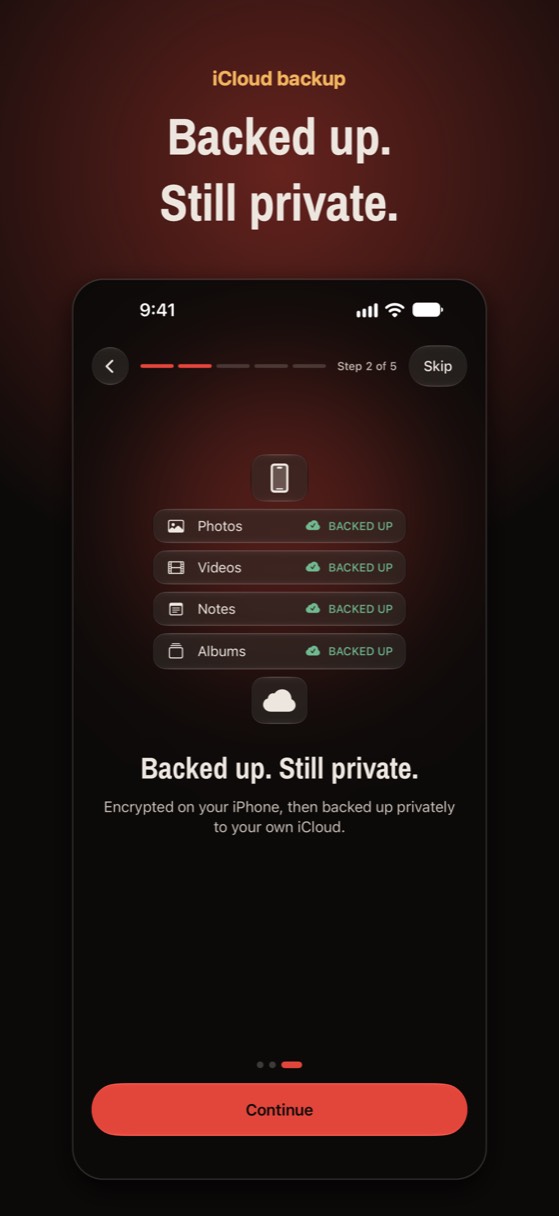
| The iCloud backup | Yes, only already-encrypted data is uploaded |
On disk, vault files carry random names and use iOS's strongest file protection class, so they are also locked by iOS while the iPhone is locked. They are left out of the iPhone's own backup on purpose; Noxium makes its own encrypted iCloud backup instead.
What about photos added from the share sheet?
They are encrypted before Noxium's main app even opens. When you use Send to Noxium from another app, the share extension encrypts each file with a new key and seals that key to a public key. The extension never holds your vault key. The next time you unlock, Noxium opens the envelope and moves the file into your vault.
How do you turn it on?
You don't need to. Encryption is always on, for every vault and every item, free or Pro.
- Set your pattern. The first time you open Noxium, draw a pattern across at least 6 bolts. This creates your first vault and its key.
- Add photos. Import from Photos, take them with the built-in camera, or use Send to Noxium. Each item is encrypted as it is added.
- Remove the originals. Copies left in the Photos app aren't protected. Turn on Settings › App settings › Offer to delete from Photos so Noxium offers to delete them after an import, then empty Collections › Utilities › Recently Deleted in Photos.
What doesn't encryption protect?
Encryption protects files at rest. It can't protect a photo while you're looking at it, or a copy outside the vault.
- An open vault. While it is unlocked, anyone holding the phone sees what you see. Use Settings › Lock after leaving and Lock when face down.
- A weak pattern. Argon2id slows guessing, but a Z-shaped pattern is still guessed quickly.
- Copies elsewhere. Originals still in Photos or iCloud Photos, screenshots, and files you export are not encrypted by Noxium.
- A compromised iPhone. Spyware, or a jailbroken phone running hostile code, can see the screen while the vault is open.
- Being forced. If someone makes you draw your pattern, encryption doesn't help. A decoy vault does.
Vault content is hidden in the app switcher and during screen recording, which covers casual glances. It isn't a defense against spyware.
Is it free or Pro?
Encryption is the same on every plan. The free plan holds 150 photos, 10 videos and unlimited notes, with full iCloud backup and restore. Noxium Pro adds unlimited items, emergency erase, iPhone and iPad sync, custom icons, album patterns and shared vaults. If Pro ends, you keep full access to view, export and back up everything already in your vault.
Encryption you can read about
Argon2id for your pattern, AES-256-GCM for every file, and only ciphertext in your own iCloud.
Download on the App Store Available on the App Store for iPhone and iPad.Questions people ask
Are photo vault apps on iPhone encrypted?
Some are, many aren't. Look for a named cipher such as AES-256, encryption on the device before backup, and no password reset by email. Our guide are photo vault apps safe? has a checklist.
Can the developer see my photos?
No. Noxium has no accounts and no servers that hold your photos. The keys come from your pattern on your iPhone, and the backup in your iCloud is already encrypted.
Isn't the iPhone already encrypted?
Yes, iOS encrypts the whole phone, but it unlocks with your iPhone passcode. Anyone who knows the passcode, or a backup made from the phone, can see your Photos library. Noxium adds a second lock with a key only your pattern makes.
What is AES-256-GCM?
AES with a 256-bit key is the standard cipher used across the industry. GCM adds a tag that detects any change to the encrypted data, so damaged or altered files don't open.
Does encryption make Noxium slow?
Unlocking takes a moment on purpose, because Argon2id is slow by design. Browsing is quick: thumbnails come first, and videos decrypt in 1 MiB chunks as they play.
Something wrong or out of date? Email business@inertiaprojects.info and we'll fix it.